
Amazon Dropshipping Automation in 2026: Replace Your Botnet with One API Call
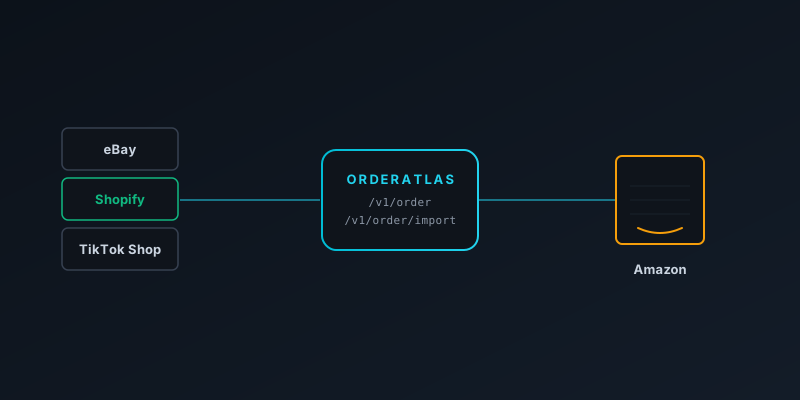
If you ran an Amazon dropshipping operation in 2023, you probably had a closet full of laptops, forty Chrome profiles, three different captcha-solving services, and a Telegram bot screaming at you whenever Akamai changed something. That stack is dead. Here's what replaced it.
What changed in 2025-2026
Amazon shipped two things that quietly killed browser-based dropshipping fulfillment:
- AWS WAF on the checkout path. Multi-region, JS-challenge-based. Headless Chrome can't pass it without a paid solver, and even then your IP gets fingerprinted across the whole flow.
- Buy-box 'soft holds' on residential proxies. If the same IP places more than a few orders, ATC starts returning empty offer-listing IDs. The browser doesn't error — it just silently fails to find a buy button.
The dropshippers who survived this didn't get better at browsers. They moved to API-first fulfillment.
The new fulfillment pipeline
Here's what a 2026-era dropshipping operator actually runs: storefront receives the order (Shopify/eBay/TikTok), an order router maps your SKU to an Amazon ASIN, OrderAtlas's POST /v1/order does the actual purchase, the conversion endpoint converts Amazon tracking to a clean carrier number, and a webhook pushes status back to your store.
Each layer is one HTTP call. No browser. No proxy management. No captcha solver subscription. The whole thing fits in 200 lines of code.
The fulfillment call, end to end
You get a customer order on Shopify. Your webhook handler maps the SKU to an ASIN, then:
unknown nodeReturns immediately with status: pending. The actual checkout runs async on our infrastructure: WAF solved, proxies rotated, tracking captured. Twenty-five seconds later your webhook fires with status: confirmed, the platform order ID, the carrier, and the tracking number — already converted to a real carrier (USPS / UPS / FedEx) so your customer never sees that the package shipped from Amazon.
Tracking conversion is the secret weapon
When you ship from Amazon to a customer who bought from your Shopify, they get an Amazon tracking number — which exposes that you sourced from Amazon. They also get an Amazon-branded shipment update.
OrderAtlas's tracking conversion fixes both. Pass convert_tracking: true on the order or as an account default. We grab the underlying carrier and tracking from Amazon's order page and surface a clean carrier number you can push to the customer. Two credits. Branded experience.
Two patterns most operators settle on
Pattern A: Sync — block the customer until Amazon confirms
You hold the customer-facing checkout page until OrderAtlas fires the success webhook. Adds 25-40s to checkout. Conversion drops a hair, but you avoid having to refund un-fulfillable orders. Good for high-AOV stores.
Pattern B: Async — confirm first, fulfill in the background
You confirm the storefront order immediately and queue the Amazon purchase. If it fails (OOS, address rejection, etc.) the OrderAtlas webhook lets you auto-refund or fall back to a second supplier. Better UX, requires you to handle exceptions.
Hot tip: combine the import endpoint with manual sourcing. POST /v1/order/import lets you tell us about an order you already placed by hand, and we'll convert tracking + push status to your webhook just like a normal API order. Useful for in-between cases.Migration in an afternoon
- Create an OrderAtlas account, generate one API key.
- In your Shopify webhook, replace the existing fulfillment block with the
POST /v1/ordercall above. - Set
webhook_urlon your account so status changes ping your shop back. - Decommission the laptops. Ship the proxies back. Cancel the captcha service.