
Bulk Buying on Amazon Without a Bot Farm: The API-First Reseller Stack
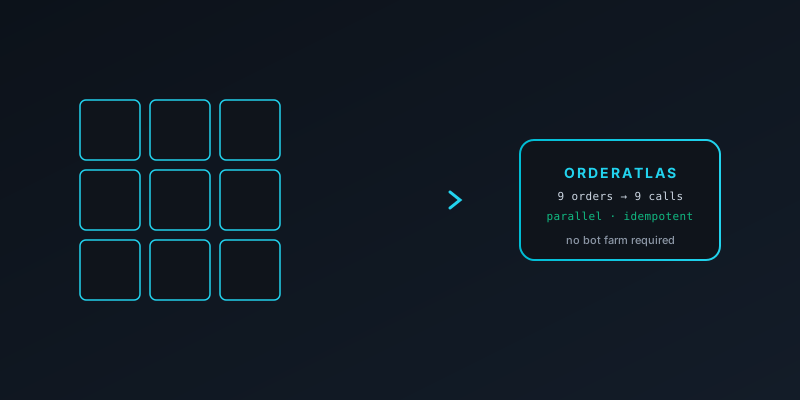
If you're doing wholesale arbitrage, retail flipping, gift-card rebuy, or any other volume buy on Amazon, the operational reality used to be brutal: every laptop a single point of failure, every account on a different proxy, every drop a coordinated panic. The dirty secret of 2026 is that the same volume now runs from a single laptop calling a single API endpoint in a loop.
Here's the stack.
What 'bulk buying' actually means in 2026
Wholesale and arbitrage operators typically run one of three shapes:
- Replenishment buying — same SKUs ordered weekly, in volumes of 5-50 per order. The operator just wants reliable fulfillment, not race-condition speed.
- Spot-buy on price drops — automated triggers off a price tracker (Keepa, CamelCamelCamel, internal data). Fires N orders the moment something hits a target.
- Gift-card / reward churn — high-volume, low-margin orders run through dedicated accounts to capture cashback or reward points.
All three look identical at the API layer. The difference is the trigger that fires the order, not the order itself.
The new architecture
One process. One Postgres queue (or even just an in-memory []string of ASINs). A worker that pulls jobs and calls OrderAtlas. That's it.
That's the entire fulfillment layer. Eight workers handle ~150-300 orders/hour depending on how much OOS retry/recovery is happening.
Cost economics
Per-order math at typical volume tiers:
- 1-249 orders/month: 2 credits × $0.50/credit = $1.00 per order
- 250-999 orders/month: 2 × $0.40 = $0.80 per order
- 1,000+ orders/month: 2 × $0.33 = $0.66 per order
Compare to bot-farm fully-loaded cost (proxies + captchas + servers + bot license + aged accounts) which runs $0.30-0.80 per order BUT demands ~30-60 hours/month of maintenance. The API approach lets one person operate at the same scale that used to need a small team.
Account management
OrderAtlas accepts your existing Amazon credentials per order. You can rotate across N accounts; we handle login + cookie persistence per account. Each account gets its own session jar, its own checkout pipeline, its own retry budget.
Pricing protection
The killer feature for bulk buyers is price_max. Pass it on every order:
If Amazon's checkout subtotal exceeds $19.99 × 5 — for any reason, including price hikes between scrape and checkout — the API refuses and refunds the credit. You won't accidentally buy a $40 item because someone changed the listing while your queue was draining.
Webhook-driven inventory tracking
Set webhook_url once on your API key. Every state change pings your endpoint:
order.created— passed gateway validationorder.confirmed— Amazon accepted the order, has platform order IDorder.shipped— carrier + tracking populatedtracking.converted— Aquiline / carrier tracking ready to pushorder.delivered— package receivedorder.failed— anything went wrong, with structured reason
Wire these into a Postgres table or a Slack channel. The whole 'where are my packages' problem disappears — your dashboard always knows.
The single biggest unlock from going API-first wasn't speed or cost. It was being able to ship a feature that depends on bulk buying without rebuilding the bot stack first.
Getting started for high-volume operators
- Create one API key per account-pool (or one per business if you don't segment).
- Top up to your monthly volume tier — credits drop to $0.33 each above 1,000.
- Run one or two workers to validate the flow against real orders.
- Once webhook delivery is stable, scale workers to your real volume.
- Cancel the bot subscriptions and recycle the proxy pool.