
Letting Claude Buy Things: Wiring an AI Agent to Amazon Checkout
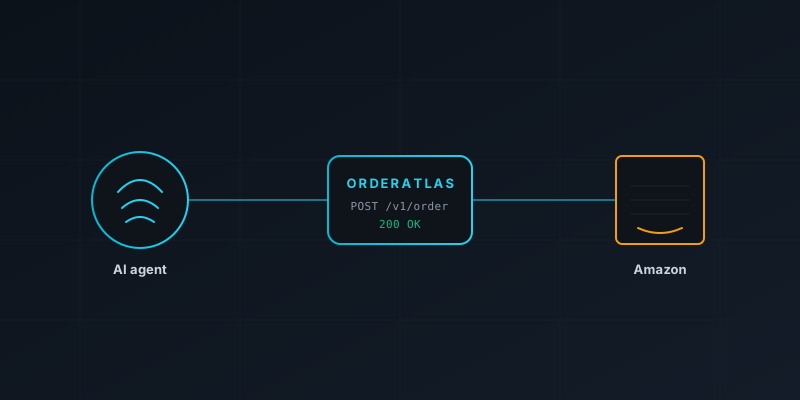
If you've spent any time building with Claude, GPT-5, or any modern agent framework, you've felt the same wall: the model is brilliant at deciding what to buy and absolutely terrible at actually buying it. Browser automation breaks on Amazon's bot detection within minutes. Headless Chrome gets WAF-blocked. Even the cleanest CDP setup eventually drowns in captchas and 'verify your identity' walls.
The fix isn't a better browser. It's a separate purchase layer the agent calls as a tool.
The architecture, in one diagram
Your agent — Claude, GPT, AutoGPT, LangGraph, whatever — handles the reasoning: which product, what budget, which shipping address, when to order. It exposes one tool to the model: place_order(asin, quantity, budget, address). That tool calls the OrderAtlas API. We do the dirty work: solving WAFs, rotating proxies, surviving Amazon's TLS fingerprint checks, recovering from OOS substitutions. The agent gets back an order ID and pricing.
The agent never touches a browser.
Wiring it up — a Claude tool definition
Here's a minimal Anthropic SDK tool that gives Claude the ability to checkout. The model picks the ASIN; we handle the actual purchase:
unknown nodeThat's it for the surface area. The model sees one tool. When it decides to buy, it emits a tool_use block, your code calls OrderAtlas, and the response goes back as tool_result. Claude sees the order ID and continues reasoning.
Three patterns that work in production
1. The 'stock alert' agent
The model polls a list of ASINs your user wants. The moment one drops below a target price (or comes back in stock), it places the order without asking. price_max is the safety rail — pass the user's budget and the API refuses if Amazon's subtotal exceeds it. No risk of the model hallucinating a $400 keyboard at $4,000.
2. The 'order from screenshot' workflow
User pastes a product image or URL. Claude's vision extracts the ASIN, checks reviews and shipping speed, then calls place_amazon_order. Latency is dominated by Amazon's checkout, not the model — about 18-30 seconds end to end depending on region.
3. The autonomous procurement agent
Replenishment buying for a small business. The agent watches inventory levels in your Notion or Google Sheet, calls a tool to look up current Amazon prices, and orders when stock dips below threshold.
Safety rails
- Per-call budget. Always pass
price_max. The API refuses orders above this regardless of what Amazon shows. - Daily/weekly caps. Enforce these in your tool wrapper, not the prompt. Models forget; code doesn't.
- Webhook confirmations. Set a webhook URL on your API key. Every state change pings your webhook with the order ID and total.
We've watched dozens of teams build agentic shopping flows on OrderAtlas. The ones that ship reliably all share one design: the model never sees credentials, only ASINs and prices. The credentials live with the API key.
Get started in five minutes
- Create an OrderAtlas API key on the dashboard.
- Top up 10 credits ($5) — enough for 5 test orders.
- Drop the tool definition above into your agent.
- Ship it.